Showing posts with label Disease. Show all posts

Saturday, February 13, 2016

Men face higher risk of cancers linked to oral sex

The Human Papilloma Virus (HPV). - File pix
                                                                The Human Papilloma Virus (HPV)
WASHINGTON: Men are twice as likely as women to get cancer of the mouth and throat linked to the human papillomavirus, or HPV, one of the most common sexually transmitted infections, researchers say.  
For men, the risk of HPV-driven cancers of the head and neck rise along with the number of oral sex partners, researchers said Friday at the American Association for the Advancement of Science (AAAS) annual meeting in the US capital.      
Nearly two out of three of these oral cancers in the United States and most western nations are caused by infection with the HPV 16 strain of the virus, and incidence of cancer is on the rise in recent years, said Gypsyamber D’Souza, who teaches epidemiology at Johns Hopkins University in Baltimore, Maryland.  
Middle-aged white men are at particularly high risk compared to other races.
“Our research shows that for men, the number of oral sex partners - as that number increases, the risk of an oral HPV infection increases,” she told reporters.  She said her research shows that youths are engaging in oral sex at increasingly young ages, compared to past generations.
But with women, the number of sexual partners does not appear to raise the risk.  
“Comparing men and women with the same number of sexual partners, a man is much more likely to become infected with oral HPV than a woman.”  
Furthermore, women who have a greater number of vaginal sex partners appear to face a lower risk of oral HPV infection, she said.  
The reason may be that when women are first exposed to HPV vaginally, they mount an immune response that prevents them from getting an oral HPV infection, she said.  
But men do not seem to have equally robust immune responses.  
“Men are not only more likely to be infected with oral HPV infection than women, but our research shows that once you become infected, men are less likely to clear this infection than women, further contributing for the cancer risk.”  
HPV infection is quite common, and most people clear the virus within a year or two, she said.  
In some cases, however, HPV does not go away and can lead to cellular changes in the mouth and throat, which eventually become cancerous.  
Oral sex may raise the risk of head and neck cancer by 22%, according to a study published January in the Journal of the American Medical Association (JAMA).
This type of cancer has risen 225% in the last two decades.  
The US Centers for Disease Control and Prevention (CDC) urges HPV vaccination for all pre-teen boys and girls so they can be protected against the infection before they become sexually active.  - AFP

Sunday, January 24, 2016

6 Facts About Zika Virus Pharmacists Should Know


An outbreak of the Zika virus is causing a stir, especially among pregnant women in affected areas because of concerns about a link between the virus and microcephaly.

Microcephaly is a birth defect in which the baby’s head and brains are often smaller than usual. Other complications may include seizures, feeding problems, hearing loss, vision issues, and developmental delay.

“Zika virus infections have been confirmed in infants with microcephaly, and in the current outbreak in Brazil, a marked increase in the number of infants born with microcephaly has been reported,” the US Centers for Disease Control and Prevention (CDC) recently stated.

However, the CDC said it is still not clear how many microcephaly cases are directly linked to Zika. Additional factors are being studied to determine whether other infections, nutrition, and the environment contribute to higher risk for microcephaly.

Nevertheless, at this time, the CDC is advising pregnant women to consider postponing travel to areas where Zika virus transmission is ongoing. If they do decide to travel, they should take all precautions against mosquito bites. 

The CDC has 3 types of travel notices for travelers and health care providers. Watch level 1 encourages usual precautions, alert level 2 recommends enhanced precautions, and warning level 3 discourages nonessential travel.


Right now, the CDC has stepped up Puerto Rico, the Caribbean, Mexico, Central America, and South America to alert level 2.

More specifically, there have been reports of Zika transmission in Barbados, Bolivia, Brazil, Colombia, Ecuador, El Salvador, French Guiana, Guadeloupe, Guatemala, Guyana, Haiti, Honduras, Martinique, Mexico, Panama, Paraguay, Saint Martin, Suriname, and Venezuela, according to the Pan American Health Organization.

Denise J. Jamieson, MD, medical officer in the CDC’s Division of Reproductive Health, told Pharmacy Timesthat pharmacists could be great resources for patient education on the Zika virus.

“Many travelers visit their pharmacy before trips abroad to fill prescriptions, get immunized, or buy other OTC medications,” Dr. Jamieson said. “That visit to the pharmacy could provide a great opportunity for patient education about Zika virus transmission and other infectious disease risks.”

She added that pharmacists could help recognize symptoms consistent with Zika-related illness when pregnant women return from their travels, as well as recommend that they see their obstetric providers.

Symptoms of the Zika virus illness include fever, rash, joint pain, and conjunctivitis, and they typically last a few days to a week.

There is neither a vaccine, nor a drug to treat or prevent Zika infection. The key to avoiding the virus is to prevent mosquito bites using insect repellant, clothing that covers all body parts, and staying indoors where there are screens on doors and windows.  

These mosquitos, which usually bite during the daytime, are the same ones that can spread dengue andchikungunya.


The CDC released interim guidelines for health care providers caring for pregnant women during this outbreak. Here are 6 recommendations pharmacists should know about:

1. All pregnant women should be asked about recent travel.
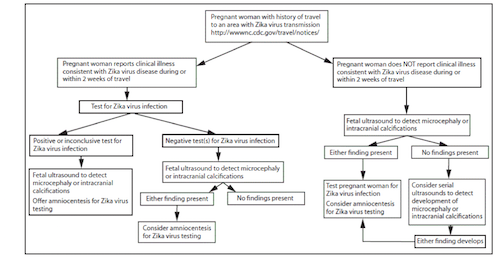
Those who have traveled where the Zika virus is circulating, are showing 2 or more symptoms related to the infection during or within 2 weeks of travel, or have ultrasounds that point to fetal microcephaly should all be tested.

Since there is no commercially available test, patients need to be screened through the CDC or state health departments. 

2. Health care providers should consult this CDC algorithm to determine appropriate steps for pregnant women who have traveled to an area affected by the Zika virus. 
 

3. Only 1 in 5 patients infected with the Zika virus become symptomatic. 
In addition to fever, rash, arthralgia, or nonpurulent conjunctivitis, some patients may develop Guillain-BarrĂ© syndrome following infection. 


4. Since there is no antiviral treatment for Zika virus disease, pharmacists can help by recommending OTC treatment options. 
Treatment may include rest, fluids, and use of analgesics and antipyretics, according to the CDC.

Acetaminophen can be used to treat fever, while aspirin and other nonsteroidal anti-inflammatory drugs should not be used, especially because of the risk for hemorrhage if the disease turns out to be dengue. 

5. Pregnant women with evidence of Zika found in serum or amniotic fluid should be monitored regularly. 
Serial ultrasounds may be warranted for fetal anatomy monitoring every 3 to 4 weeks.

Patients are encouraged to seek help from a maternal-fetal medicine or infectious disease specialist with expertise in pregnancy management.

6. Tests for the Zika virus are not 100% reliable.
William Schaffner, chairman of preventive medicine at Vanderbilt University, told The New York Times that some of the tests come back with false positives, while others are not effective at determining results until late in the pregnancy.

Source: http://www.pharmacytimes.com/